 Skip to content

Cutting Downtime, Boosting ROI: A Real-World Success with ADIM
How a Southeastern Printer Achieved Over $420K in Annual Savings with Daetwyler’s ADIM Process
How do you reduce operational costs by nearly half without compromising output quality? With Daetwyler’s ADIM approach—Analyze, Design, Implement, Measure—one major printer found out how a few critical changes to their workflow and consumables led to dramatic, measurable savings across six presses.
Before Daetwyler
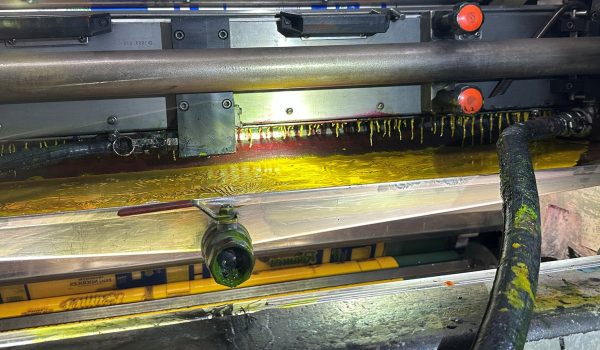
A high-output flexographic printer in the Southeast was facing persistent and costly downtime. Their teams were spending 20–25 hours per week dealing with issues like:
- End seal leaks
- Back doctoring
- Frequent stops to clean dirty print plates
Before partnering with Daetwyler, the pressroom was facing common but costly issues—back doctoring, seal leakage, and ink contamination on sleeves and press components—clearly visible in images like those below.
ADIM in Action
Daetwyler’s technical team partnered with the plant manager, corporate ink manager, and director of printing to roll out their proven ADIM methodology.
Analyze
The team began with a press-side assessment, operator interviews, and data review to identify the primary causes of downtime. Key issues included end seal leakage, back doctoring, and ink contamination on adjacent components.
These problems were clearly visible onsite and confirmed by operators, yet frequently misdiagnosed—leading to overcorrections like excessive chamber pressure or repeated cleanups. This thorough analysis provided a data-backed foundation for designing a targeted solution.
Design
Custom trials were developed to test optimized blade and end seal setups based on the plant’s anilox specifications. Trials ran across multiple press stations over 24-hour periods, with daily progress reports delivered to leadership. A cost-impact projection supported internal alignment and buy-in.
Implement
Measure
After Daetwyler: The Results

| Metric | Before (Competitor) | After (Daetwyler) |
|---|---|---|
| Blade Change Interval | Every 2.5 Days | Every 5 Days |
| Downtime per Press (Annual) | 138 Hours | 69 Hours |
| Downtime Cost per Press | $110,400 | $55,200 |
| Consumables per Press | $39,728.78 | $24,465.32 |
| Total Cost per Press | $150,128.78 | $79,665.32 |
| Total Cost (All 6 Presses) | $900,772.70 | $477,991.94 |
| Annual Savings | $422,780.77 |
Beyond the Numbers: Training for Long-Term Success
When measured against real post-rollout data, actual savings came in at $420,654.55—a nearly 47% reduction in total spend.
The Daetwyler team also delivered targeted seminars covering:
- Proper blade/end seal setup
- Installation best practices
- Maintenance routines to reduce plate contamination
- Hands-on training matched to each press’s anilox specs
- Q&A support and follow-up training
The Bottom Line
This success story shows how a data-driven, consultative approach like ADIM can cut costs, boost uptime, and build long-term operational resilience. And while every plant is different, the results speak for themselves: consistent ROI with expert support at every stage.
